

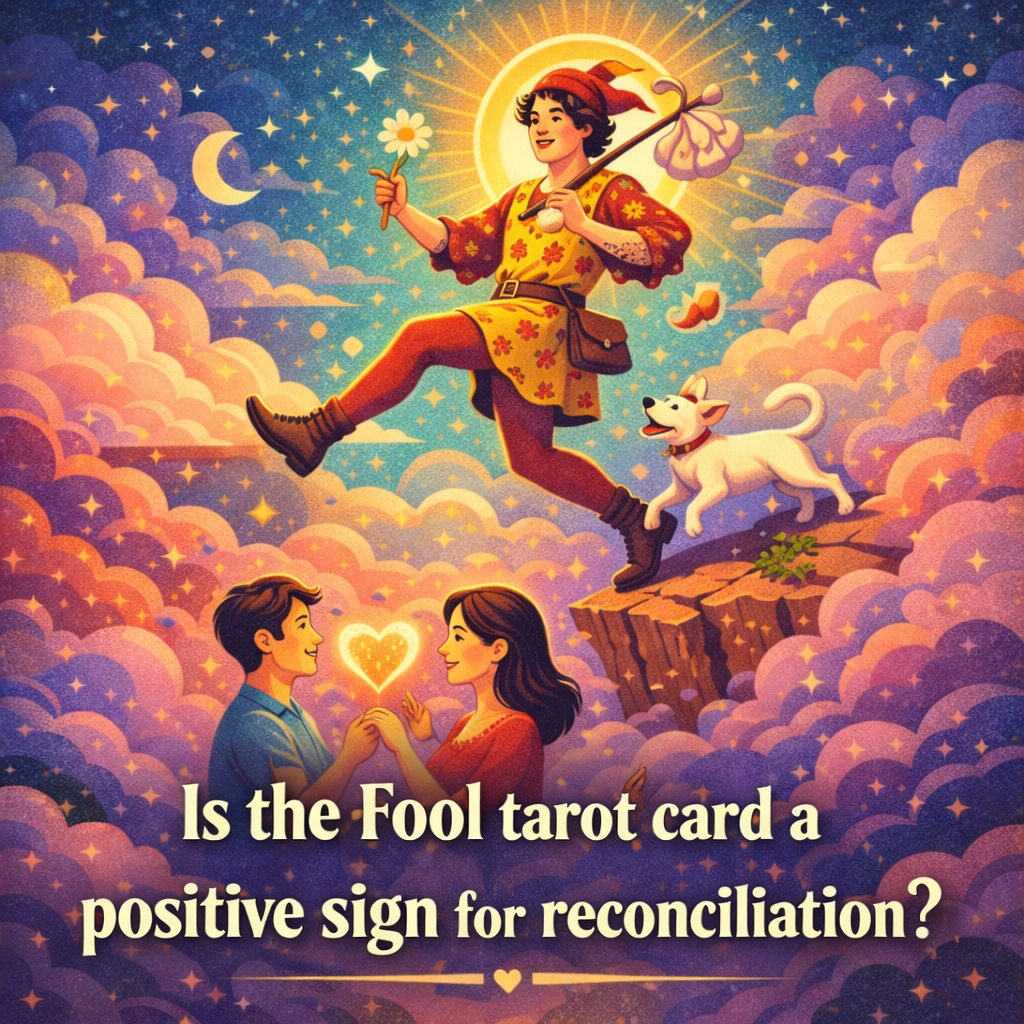
Según los expertos de Astroideal, Reconciliation questions often arise when emotions are mixed—hope exists, but so does uncertainty about whether reconnecting is wise or sustainable. Tarot is frequently consulted at this stage not to guarantee outcomes, but to clarify emotional readiness, patterns, and potential direction. When the Fool tarot card appears in reconciliation-focused readings, reactions are often divided. Some see it as optimistic and fresh, while others worry it signals immaturity or unrealistic expectations.

💜 Need a clear answer right now?
CONSULT THE YES OR NO TAROT Free · No registration · Instant resultMany practitioners believe the Fool does not answer reconciliation questions with a simple yes or no. Instead, it reframes reconciliation as a new beginning, one that requires openness, self-awareness, and a willingness to release past baggage.
Using interpretive strategies commonly discussed in analytical resources such as cards meanings, readers often explore whether reconciliation represents growth or a repetition of old mistakes.
This article examines whether the Fool tarot card can be considered a positive sign for reconciliation, maintaining a balanced, credible tone without guarantees.
Core Symbolism of the Fool in Reconciliation Readings
New Beginnings Rather Than Continuation
The Fool is traditionally associated with beginnings. In reconciliation readings, many practitioners interpret this as starting anew rather than resuming where things left off. This distinction is critical.
Reconciliation under the Fool often implies that the old relationship dynamic must be released for anything healthy to emerge.
Openness, Trust, and Emotional Risk
Another central theme of the Fool is trust. Emotionally, this reflects a willingness to step forward without full certainty. In reconciliation contexts, this may involve vulnerability and risk.
Practitioners often caution that trust should be balanced with awareness rather than blind optimism.
Freedom From Past Narratives
The Fool is also linked to freedom—especially from limiting narratives. In reconciliation readings, this may suggest releasing blame, resentment, or rigid expectations that previously defined the connection.
This does not mean forgetting the past, but not being controlled by it.
Upright Fool: Reconciliation Meanings Explained
A Clean Slate Approach to Reconnection
When the Fool appears upright, many practitioners interpret it as the possibility of a clean slate. Reconciliation may be viable if both individuals are genuinely willing to approach each other without carrying unresolved baggage.
This often requires redefining boundaries and expectations entirely.
Emotional Openness and Curiosity
The upright Fool frequently reflects curiosity rather than certainty. In reconciliation, this may indicate openness to exploring connection again without forcing outcomes.
Practitioners often view this as positive when paired with honesty and communication.
Lightness After Emotional Heaviness
In some cases, the Fool appears after periods of emotional heaviness. Its presence can suggest relief from emotional burden and a chance to reconnect without past intensity dominating every interaction.
Reversed Fool: Risks and Emotional Naivety
Repeating Old Mistakes
When reversed, the Fool is often interpreted as recklessness or lack of awareness. In reconciliation readings, this may suggest returning to a relationship without addressing why it ended.
Practitioners frequently caution against confusing nostalgia with growth.
Ignoring Red Flags
A reversed Fool can also indicate ignoring warning signs. Reconciliation under this influence may feel exciting initially but lacks grounding.
This interpretation emphasizes the need for discernment rather than avoidance.
Fear of Starting Over Alone
Sometimes the reversed Fool reflects fear rather than hope—fear of being alone, fear of change, or fear of moving forward independently.
In these cases, reconciliation may be driven by comfort rather than compatibility.
Relationship Patterns Commonly Linked to the Fool
On-and-Off Connections
The Fool often appears in readings involving cyclical or on-and-off relationships. Practitioners interpret this as highlighting the need to break repetitive loops through conscious choice.
Reconciliation is only constructive if patterns truly change.
Youthful or Inexperienced Dynamics
The Fool may reflect emotional immaturity or lack of experience—either historically or currently. In reconciliation, this can be positive if growth has occurred, or risky if it has not.
Context is essential here.
Reconnection After Personal Growth
In more positive interpretations, the Fool appears when both individuals have grown independently. Reconciliation then reflects a new chapter rather than regression.
Seeking Perspective on Reconciliation Decisions
When Hope Feels Strong but Clarity Is Uncertain
Hope can cloud judgment during reconciliation. Some individuals seek insight from qualified professionals who interpret tarot ethically, helping distinguish between healthy openness and emotional impulsivity.
Such guidance often emphasizes self-awareness over prediction.
Emotional Renewal and Romantic Curiosity
The Fool frequently appears in love tarot readings when emotional curiosity is present but outcomes are undefined. Practitioners often stress that curiosity should be explored consciously rather than blindly.
Practical Guidance When the Fool Appears for Reconciliation
Reflective Steps Commonly Suggested
When the Fool arises in reconciliation readings, practitioners often recommend intentional reflection:
- Clarifying what would truly be different this time
- Acknowledging past lessons without self-judgment
- Setting clear boundaries before reconnecting
Potential Benefits of Fool-Inspired Reconciliation
When handled responsibly, many believe the Fool can support:
- Emotional renewal
- Reduced resentment
- Openness to healthier connection
Choosing Balanced Interpretive Support
Because the Fool can amplify optimism, practitioners often suggest consulting reliable readers who emphasize realism and accountability alongside hope.
Comparing Reconciliation Paths With the Fool
| Reconciliation Approach | Fool Influence | Likely Outcome |
|---|---|---|
| Blind optimism | High risk | Repeated patterns |
| Conscious fresh start | Integrated | Emotional growth |
| Fear-driven return | Unstable | Short-term comfort |
Modern Reconciliation Readings and Accessibility
Digital Tarot for Thoughtful Reconnection
With access to online tarot sessions, individuals considering reconciliation can reflect privately and thoughtfully, rather than acting from emotional impulse.
These formats often support paced decision-making.
Visual and Voice-Based Reading Options
Some people prefer video readings for nuanced emotional discussion, while others feel more comfortable with phone readings when processing sensitive reconciliation questions discreetly.
Choosing the right format can support emotional grounding.
Timing, Cycles, and Readiness for Reconciliation
The Fool and Reconciliation Timing
The Fool is not associated with certainty or fixed timing. Practitioners often interpret it as suggesting readiness for exploration, not commitment.
Time is needed to observe whether openness evolves into stability.
Integrating Broader Emotional Cycles
Some readers contextualize Fool-related reconciliation insights alongside horoscope insights to reflect broader cycles of renewal, risk-taking, and personal growth.
In reflective practice, practitioners often revisit symbolic frameworks using cards meanings to reassess readiness as understanding matures.
Frequently Asked Questions
Is the Fool a positive sign for reconciliation?
It can be, if reconciliation represents a genuine new beginning rather than repetition.
Does the Fool guarantee reconciliation?
No. Practitioners view it as highlighting potential, not outcomes.
What does a reversed Fool mean for reconciliation?
It often suggests risk, naivety, or avoidance of past lessons.
Can the Fool indicate emotional growth?
Yes, particularly when paired with self-awareness and honesty.
Should reconciliation be attempted immediately with this card?
Most practitioners suggest proceeding slowly and mindfully.
How often should reconciliation readings be revisited?
Usually only after emotional circumstances or understanding changes meaningfully.
Conclusion
The Fool tarot card offers a nuanced message when it appears in reconciliation readings. Rather than promising reunion or warning against it outright, it asks a deeper question: Is this truly a new beginning, or a return to the familiar?
Many practitioners believe the Fool can be a positive sign for reconciliation when openness is balanced with awareness and past lessons are genuinely integrated.
When interpreted thoughtfully, the Fool reminds us that reconciliation is not about undoing the past, but about stepping forward with clarity, curiosity, and conscious choice.
The Fool Card in Reconciliation Readings: Positive or Negative?
| Context | The Fool’s Message | Positive? | What It Requires |
|---|---|---|---|
| Fresh start after conflict | Both parties ready for a new beginning | Yes | Willingness to start fresh |
| Premature reconciliation | Rushing back before lessons are learned | Caution | More time and growth needed |
| Old patterns repeating | The cycle may restart without change | Caution | Conscious evolution required |
| Genuine new chapter | This time truly is different | Yes | Both have changed significantly |
| Uncertainty about outcome | The leap is possible but destination unknown | Mixed | Acceptance of not knowing |
The Fool in Combination with Other Reconciliation Cards
| Combination | Reconciliation Meaning | Signal Strength |
|---|---|---|
| The Fool + The Lovers | Strong signal for a meaningful new beginning together | Very Positive |
| The Fool + Judgment | Both have grown and genuinely risen to a new level | Very Positive |
| The Fool + The Tower | Risk of jumping back into an unstable situation | Caution |
| The Fool + Six of Cups | Nostalgia-driven reconciliation — ensure it’s not just longing | Mixed |
| The Fool + Ten of Cups | New beginning leading to lasting emotional fulfillment | Very Positive |
| The Fool + Five of Swords | Proceeding naively into a potentially damaging dynamic | Caution |
Limitations of This Interpretation
No tarot interpretation is universal or deterministic. Meaning varies according to each person’s personal, cultural, and emotional context.
Use this guide as a starting point for your own reflection, not as absolute truth or a substitute for professional advice.
Preguntas frecuentes
¿Is The Fool a positive card for reconciliation in tarot?
The Fool can be a positive sign for reconciliation when it represents a genuine new beginning — both parties have grown, learned from the past, and are ready to start fresh without repeating old patterns. However, if it appears alongside cards like The Tower or Five of Swords, it may warn of leaping back in too quickly without real change.
¿What does The Fool mean when asking about getting back with an ex?
The Fool in a reconciliation reading often signals a crossroads: are you truly beginning something new and evolved, or are you naively returning to an unchanged situation out of longing? The surrounding cards determine which interpretation applies. Context is essential — The Fool never tells the full story alone.
¿Does The Fool indicate a new relationship beginning with an ex?
Yes, when The Fool appears with The Lovers, Judgment, or Ten of Cups, it strongly suggests that the reconciliation would represent a genuinely new chapter — not a replay of the old relationship. The key is whether both individuals have grown sufficiently for the dynamic to truly be different this time.
¿Is The Fool card in reconciliation a sign to take a leap of faith?
Sometimes. The Fool embodies the sacred leap of faith — stepping off the cliff into the unknown. For reconciliation, this means being willing to risk vulnerability again. But a mindful Fool also checks that the cliff doesn’t drop into a pattern that has already caused harm. Wisdom accompanies the leap.
¿What is the shadow side of The Fool in love readings?
The Fool’s shadow is naivety and impulsiveness — leaping before looking, returning to the same dynamic hoping for different results. In love readings, this manifests as romantic idealism that overrides honest assessment of whether the core issues that caused the breakup have genuinely been addressed.
¿What other cards should appear with The Fool for a positive reconciliation reading?
The Lovers, Judgment, Ten of Cups, and The Star alongside The Fool create a very encouraging picture for reconciliation. These cards add depth, growth, emotional fulfillment, and hope to The Fool’s new beginning energy. Avoid alarm only when The Fool appears with repeated Swords and Tower imagery.
¿Does a reversed Fool indicate that reconciliation won’t happen?
A reversed Fool in a reconciliation reading may indicate hesitation, self-sabotage, or a reluctance to take the necessary risk. It can also suggest that the person being asked about is not yet ready to make the leap — that fear or unresolved hurt is holding them back from opening to reconciliation.
¿How many times can The Fool appear in a series of reconciliation readings?
If The Fool repeatedly appears in readings about the same reconciliation question over months, it may signal that while the energy of a new beginning is present, neither party is yet acting on it. Repeated appearance without progress may indicate that the ‘leap’ requires more concrete action, not just energetic readiness.
¿What spiritual message does The Fool carry for relationship reconciliation?
Spiritually, The Fool reminds us that all new beginnings require trust — trust in the other person’s growth, trust in our own resilience, and trust in the relationship’s potential to evolve beyond its past. It asks: are you willing to release the weight of history and step into possibility?
¿Should I reach out to my ex if The Fool appears in my reading?
The Fool’s energy supports the impulse to reach out — but with genuine openness rather than desperate need. If you feel led to contact your ex after seeing this card, do so lightly, without attachment to a specific outcome. The Fool reaches out with an open heart, not a predetermined expectation of what must happen next.
¿What is the difference between The Fool and The Star for reconciliation?
The Fool is about the active leap — taking the initiative to begin again. The Star is about hope, healing, and the patience to wait for the right moment of natural reconnection. If both appear, they suggest that healing is needed first (Star), followed by the courage to initiate (Fool) when the time is right.
Related Articles
Ready for a professional tarot reading? Connect with our experts at Astroideal.
