

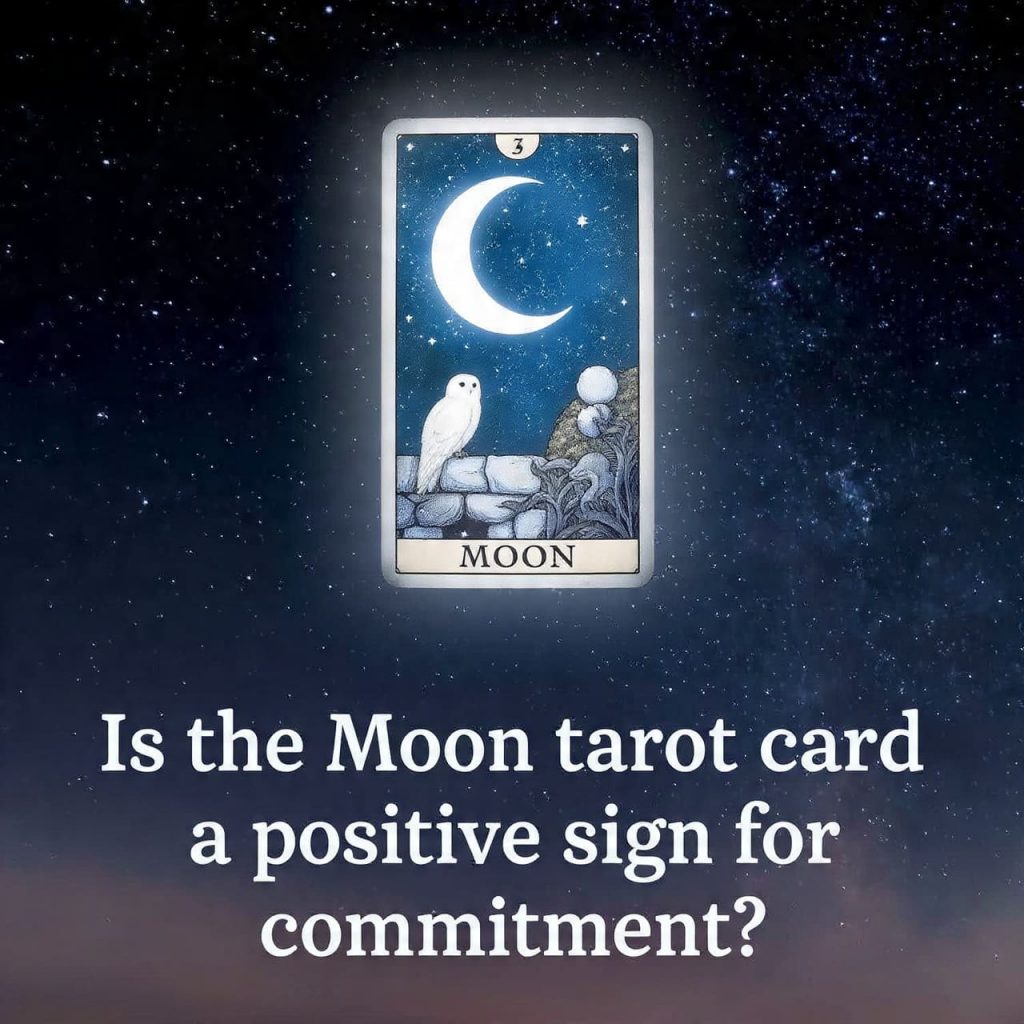
According to Astroideal experts, When the Moon tarot card appears in a commitment-focused reading, it often triggers mixed emotions. Commitment is usually associated with clarity, certainty, and emotional security, while the Moon is linked to ambiguity, subconscious fears, and unseen influences. Because of this contrast, many people immediately wonder whether the Moon is a warning sign or a signal to proceed with caution.

💜 Need a clear answer right now?
CONSULT THE YES OR NO TAROT Free · No registration · Instant resultPractitioners generally agree that the Moon is neither strictly positive nor negative. Instead, it reflects emotional depth and psychological complexity. In commitment readings, the Moon often appears when feelings are real but not fully understood, or when intuition and fear are difficult to separate. Interpretive frameworks discussed in cards meanings emphasize that the Moon works on an inner level, highlighting what is unspoken, hidden, or unresolved rather than delivering direct answers.
This article explores whether the Moon tarot card can be considered a positive sign for commitment, how practitioners interpret it in different scenarios, and how its message can be applied responsibly without fear or unrealistic expectations.
Understanding the Moon Tarot Card in Commitment Readings
Core Symbolism and Emotional Undercurrents
The Moon traditionally symbolizes intuition, illusion, uncertainty, and the subconscious mind. In commitment readings, practitioners often interpret this as emotional complexity beneath the surface. Feelings may be genuine, but doubts, fears, or past experiences are influencing how commitment is perceived.
The Moon suggests that clarity has not yet fully emerged.
Upright Meaning for Commitment Questions
When upright, the Moon is commonly interpreted as emotional uncertainty rather than lack of commitment. Practitioners suggest it may indicate hesitation, fear of vulnerability, or confusion about long-term expectations.
In readings conducted by qualified professionals, the upright Moon is often framed as an invitation to explore emotional truth before making binding decisions.
Reversed Moon and Shifting Awareness
Reversed interpretations vary. Some practitioners believe a reversed Moon indicates that confusion is beginning to lift. Others interpret it as emotional avoidance—choosing not to see uncomfortable truths.
In commitment contexts, reversal often signals that clarity is possible, but honesty is required.
Is the Moon a Positive or Negative Sign for Commitment?
Emotional Honesty Over Emotional Comfort
Many practitioners resist labeling the Moon as negative. Instead, they describe it as emotionally honest. It reveals what is unresolved so that commitment decisions are not made blindly.
From this perspective, the Moon can be positive because it prevents premature commitment.
When the Moon Feels Challenging
The Moon can feel uncomfortable because it removes illusions. Practitioners often note that it appears when surface-level reassurance is no longer enough.
This discomfort often precedes emotional maturity.
The Importance of Balanced Interpretation
Because the Moon is easy to misinterpret as betrayal or deception, many people seek guidance from reliable readers who emphasize emotional nuance rather than fear-based conclusions.
Emotional and Spiritual Lessons of the Moon in Commitment
Subconscious Fears and Attachment Patterns
Spiritually, the Moon highlights subconscious fears. In commitment readings, practitioners often interpret it as revealing fears of abandonment, loss of independence, or repeating past relationship wounds.
Recognizing these fears is a step toward healthier commitment.
Intuition Versus Anxiety
One of the Moon’s core lessons is discernment. Practitioners emphasize the importance of distinguishing calm intuition from anxiety-driven thoughts. Anxiety feels urgent and overwhelming, while intuition feels quiet and steady.
This distinction is essential when evaluating commitment.
Emotional Responsibility in Long-Term Bonds
The Moon suggests that commitment requires emotional responsibility—not just desire. Ignoring emotional undercurrents often leads to instability later.
The Moon in Different Commitment Scenarios
Early-Stage Commitment
In early relationships, the Moon often reflects mixed feelings. Practitioners interpret it as uncertainty about pacing, expectations, or emotional safety rather than lack of interest.
Rushing commitment under Moon energy is rarely advised.
Established Relationships Considering Deeper Commitment
In long-term relationships, the Moon may indicate emotional drift, unspoken dissatisfaction, or confusion about shared direction. Practitioners suggest addressing these layers before formalizing commitment.
Ignoring emotional signals can deepen disconnection.
Commitment Questions Versus Emotional Readings
While emotional reassurance often dominates love tarot readings, the Moon’s role in commitment readings focuses more on awareness than prediction.
Practical Guidance When the Moon Appears for Commitment
Slowing Down Decision-Making
A central message of the Moon is patience. Practitioners often advise delaying major commitment decisions until emotional clarity improves.
Time allows truth to surface naturally.
Constructive Steps Many Practitioners Suggest
When the Moon appears in commitment readings, readers often recommend:
- Reflecting honestly on fears around commitment
- Avoiding assumptions based on insecurity
- Creating space for calm, open communication
- Observing actions over promises
These steps support clarity without pressure.
Accessing Reflective Commitment Support
Because Moon energy benefits from thoughtful exploration, many individuals choose online tarot sessions that allow reflective dialogue rather than emotionally charged predictions.
The Moon Compared to Other Commitment-Related Tarot Cards
Moon Versus The High Priestess
The High Priestess represents calm inner knowing, while the Moon represents intuition clouded by fear. Practitioners often interpret the Moon as insight still forming, whereas the High Priestess reflects clarity already accessed.
Understanding this difference prevents misinterpretation.
Moon Versus The Devil
The Devil highlights conscious attachment, while the Moon highlights unconscious fear. In commitment readings, the Moon often appears before attachment patterns are fully recognized.
Awareness comes before release.
Commitment Timing and Broader Cycles
Some practitioners contextualize the Moon within larger emotional cycles, occasionally referencing horoscope insights to explore periods when introspection and emotional processing influence commitment decisions.
Professional Commitment Tarot and Modern Practice
How Complex Emotional Cards Are Read Ethically
Modern tarot practice emphasizes emotional responsibility. Practitioners frame the Moon as a tool for awareness rather than a verdict on commitment success or failure.
This approach reduces anxiety and dependency.
Reading Formats, Pricing, and Accessibility
Commitment-focused tarot readings involving introspective cards like the Moon are available in multiple formats.
| Format | Typical Duration | General Cost Range | Best For |
|---|---|---|---|
| Written insight | 20–30 minutes | Lower range | Private reflection |
| Live voice session | 30–45 minutes | Mid range | Emotional clarity |
| Interactive video | 45–60 minutes | Higher range | Deep emotional exploration |
Some individuals prefer nuanced discussion through video readings, while others choose phone readings when privacy supports honest self-exploration.
Accuracy, Readiness, and Commitment Tarot
Why the Moon Avoids Absolutes
The Moon reflects evolving emotional conditions rather than fixed outcomes. Practitioners suggest that accuracy improves when commitment is viewed as a process rather than a single decision.
This perspective aligns with emotional realism.
Choosing the Right Reading Style
Because Moon energy unfolds gradually, formats that allow dialogue or follow-up often provide better insight than one-time predictions.
Accessibility and emotional safety matter.
Integrating Insight Over Time
Moon-related commitment insights often clarify over weeks or months. Practitioners advise revisiting guidance as emotions shift rather than expecting instant certainty.
Frequently Asked Questions
Is the Moon a bad sign for commitment?
Most practitioners suggest it is neutral. It reflects emotional complexity, not rejection.
Does the Moon mean someone is hiding something?
Not always. It often indicates unspoken feelings rather than intentional secrecy.
Should I commit if the Moon appears?
Practitioners usually advise waiting until emotional clarity improves.
What if the Moon appears reversed?
It may indicate confusion lifting or emotional truths emerging.
Can the Moon indicate fear of commitment?
Yes. It often highlights subconscious fear rather than lack of desire.
How long does Moon energy last in commitment?
There is no fixed timeframe. It lasts until emotional clarity is restored.
Conclusion
The Moon tarot card is not a simple yes-or-no answer when it comes to commitment. Rather than signaling failure or success, it reflects emotional depth, subconscious fear, and the need for inner honesty. Many practitioners view the Moon as a protective card—it slows commitment decisions until truth, trust, and emotional clarity can develop.
When interpreted thoughtfully and without fear, the Moon becomes a guide rather than a warning. It reminds us that meaningful commitment cannot be built on confusion or illusion, but on self-awareness, emotional responsibility, and the courage to face what lies beneath the surface before moving forward.
Key Aspects Comparison
| Aspect | Description | Recommendation |
|---|---|---|
| Preparation | Mental and emotional state before consultation | Meditate 5 minutes and define your question |
| Frequency | How often to consult tarot | Maximum once a month per topic |
| Question type | Open vs closed questions | Use open questions (How…? What…?) |
| Platform | Online vs in-person | Both valid; prioritize trust in the reader |
| Cost | Investment in a quality reading | $15-100; avoid free services without guarantees |
| Follow-up | What to do after the reading | Note the cards and reflect for several days |
Types of Spreads and Experience Levels
| Spread Type | No. of Cards | Ideal For | Estimated Duration |
|---|---|---|---|
| Single card | 1 | Quick daily guidance | 5-10 min |
| Three-card spread | 3 | Past-present-future | 15-20 min |
| Celtic Cross | 10 | In-depth analysis of complex situations | 30-45 min |
| Love spread | 5-7 | Romantic relationships | 20-30 min |
| Career spread | 5-6 | Professional decisions | 20-30 min |
| Annual spread | 12-13 | Overview of the year ahead | 45-60 min |
Limitations of This Interpretation
Tarot is a personal guidance tool, not an exact science or a substitute for professional advice. Interpretations can vary based on each person’s cultural, emotional, and personal context.
Use this information as a starting point for personal reflection, not as absolute truth. For serious health, legal, or financial matters, always consult qualified professionals.
Preguntas frecuentes
¿Is tarot reading reliable for making important decisions?
Tarot is a tool for introspection and guidance, not an infallible oracle. According to Astroideal experts, it can help you explore options and connect with your intuition, but should always be complemented with your own judgment and professional advice when needed.
¿How much does a quality tarot reading cost?
A professional tarot reading typically ranges from $15 to $100 depending on the platform, the reader’s experience, and session length. Astroideal offers certified readers with transparent pricing and no hidden fees.
¿How often should I get a tarot reading?
There’s no universal frequency, but experts recommend not consulting on the same topic more than once a month to avoid dependency. A seasonal or monthly reading is usually sufficient for general guidance.
¿What types of questions work best for tarot?
Open-ended questions like ‘What should I consider about…?’ or ‘How can I improve…?’ yield better results than yes/no questions. Tarot reflects energies and tendencies, not fixed facts.
¿Can tarot accurately predict the future?
Tarot does not predict the future deterministically. It shows tendencies based on the current moment. Your actions and decisions can always change the path the cards suggest.
¿Do I need prior knowledge to understand a tarot reading?
No. A good reader will explain each card and its meaning in the context of your situation. At Astroideal, you’ll receive a clear and understandable interpretation without unnecessary jargon.
¿Is there a difference between online and in-person tarot readings?
Distance doesn’t affect the quality of an energetic reading. Phone or video tarot can be just as accurate as in-person sessions. The most important factor is mental connection and preparation before the consultation.
¿How should I prepare for a tarot reading?
Reflect on your question or situation beforehand. Find a quiet place, free from distractions. Clearly define which area of your life you want to explore: love, career, health, or personal circumstances.
¿Does tarot have a scientific basis?
Tarot is not scientifically validated as a predictive method. However, as a psychological and self-knowledge tool, it has proven useful for many people who use it as reflective guidance, not absolute truth.
¿Can health topics be addressed in tarot?
Tarot can offer emotional or psychological perspectives related to health, but should never replace professional medical diagnosis. For serious health matters, always consult a qualified physician.
¿What makes Astroideal’s tarot service different from other platforms?
Astroideal features verified readers, real user reviews, and full pricing transparency. It offers specialized consultations by area (love, career, spirituality) with guaranteed confidentiality and personalized attention.
Related Articles
Ready for your personalized reading? Consult with our Astroideal experts and get clear answers today.
