

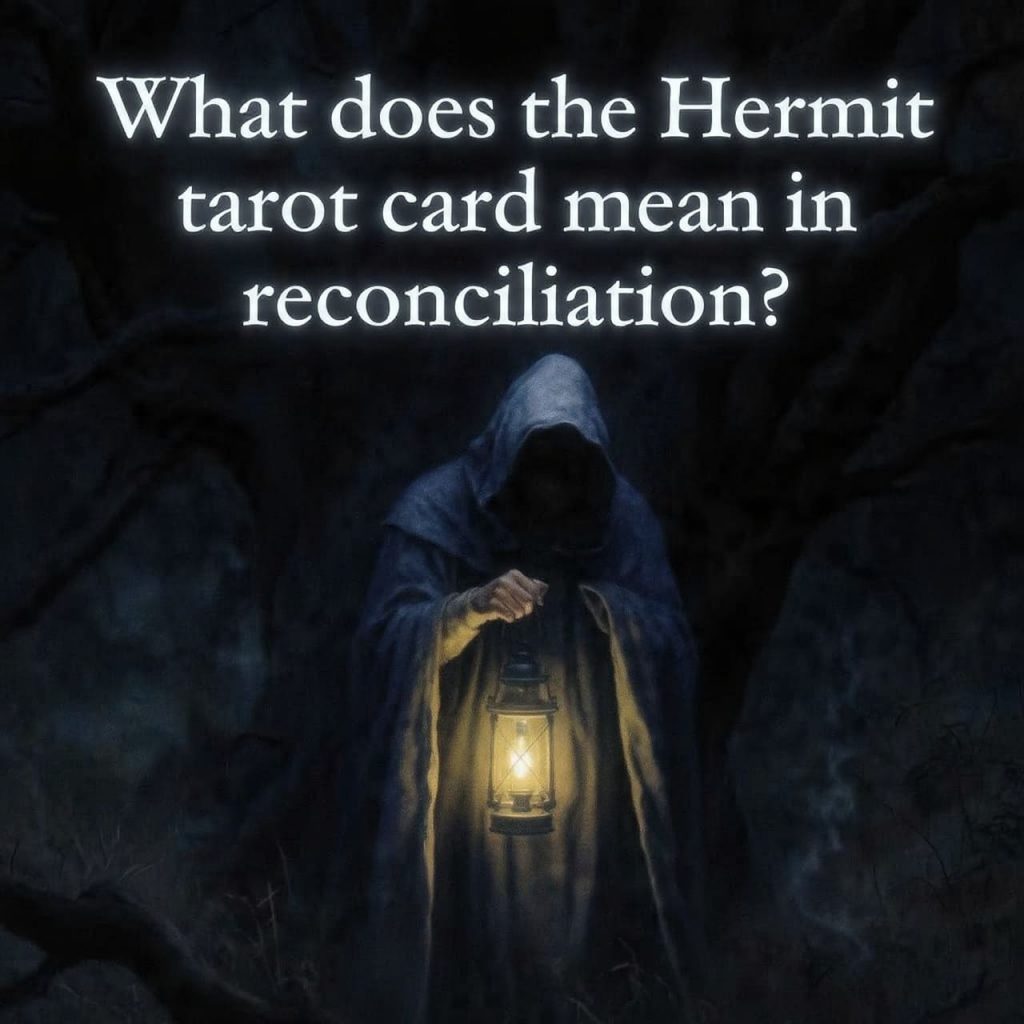
When the Hermit tarot card appears in a reconciliation reading, it often raises mixed emotions. For many people hoping for reunion, the image of solitude and withdrawal can feel discouraging. The Hermit does not suggest rushing back together, dramatic declarations, or immediate emotional closeness. Instead, it represents reflection, distance, and inner truth. In reconciliation contexts, this can feel counterintuitive—yet practitioners consistently emphasize that the Hermit carries a deeply important message about how reconciliation may unfold, not whether it is impossible.

💜 Need a clear answer right now?
CONSULT THE YES OR NO TAROT Free · No registration · Instant resultSpiritually and psychologically, the Hermit is associated with wisdom gained through introspection. Interpretive approaches commonly discussed in resources such as cards meanings stress that this card must be read through process rather than outcome. In reconciliation readings, the Hermit often indicates that clarity, healing, and honest self-examination are prerequisites before any reunion can be healthy or sustainable.
This article explains what the Hermit tarot card means in reconciliation, how practitioners interpret its presence, and how its guidance can be applied constructively when considering whether and how two people may come back together.
Understanding the Hermit Tarot Card in Relationship Readings
Core Symbolism and Emotional Themes
The Hermit traditionally symbolizes solitude, introspection, and inner guidance. In relationship readings, practitioners often interpret it as emotional withdrawal—not necessarily rejection, but a conscious step back to gain clarity. The lantern the Hermit carries is frequently described as inner truth illuminated through reflection.
In reconciliation contexts, this symbolism suggests that understanding must come before reconnection.
Upright Meaning in Reconciliation Contexts
When upright, the Hermit is commonly interpreted as a period of separation that serves a purpose. Practitioners suggest it may indicate that one or both individuals need time alone to process emotions, understand past dynamics, or reconnect with personal values.
In readings conducted by qualified professionals, the upright Hermit is often framed as a healing pause rather than a permanent ending.
Reversed Interpretations and Emotional Avoidance
Reversed interpretations vary. Some practitioners believe a reversed Hermit points to isolation that has become avoidance, while others see it as resistance to introspection. In reconciliation readings, this may suggest that silence or distance is prolonging confusion rather than resolving it.
The reversed Hermit often highlights the need to balance reflection with communication.
Is the Hermit a Positive Sign for Reconciliation?
When Distance Supports Healing
Many practitioners consider the Hermit a positive sign for reconciliation when past issues were rooted in misunderstanding, emotional overwhelm, or lack of self-awareness. The card suggests that reunion without insight would repeat old patterns.
In this sense, the Hermit protects future connection by slowing the process.
When the Message Feels Neutral or Challenging
The Hermit is not a card of reassurance. It may feel neutral or even discouraging when someone desires immediate contact. Practitioners often describe it as honest rather than comforting.
Its value lies in long-term emotional clarity, not short-term relief.
The Role of Ethical Interpretation
Because reconciliation readings can carry strong emotional hope, interpretation must be handled responsibly. Many people therefore seek guidance from reliable readers who avoid definitive promises and instead focus on personal growth and timing.
The Hermit’s Role in Different Reconciliation Scenarios
After a Breakup Driven by Conflict
When reconciliation follows conflict, the Hermit often reflects the need to step away from emotional reactivity. Practitioners believe the card indicates that understanding one’s own role in the conflict is essential before reconnecting.
This introspection can prevent repeating harmful cycles.
Situations Involving Silence or No Contact
In no-contact situations, the Hermit frequently appears to validate the pause. Practitioners suggest it may indicate that silence is being used for reflection rather than disinterest.
However, it also cautions against assuming that distance automatically leads to reunion.
Differentiating Emotional Healing From Romantic Prediction
While emotionally focused interpretations are common in love tarot readings, the Hermit in reconciliation readings emphasizes inner work over external outcome. It reflects preparation rather than promise.
Spiritual and Psychological Themes of the Hermit in Reconciliation
Self-Discovery Before Reunion
A core lesson of the Hermit is self-discovery. Practitioners often interpret the card as asking what each person has learned during separation. Reconciliation, if it occurs, is meant to be informed by this insight.
Without growth, reunion may feel familiar but unsatisfying.
Releasing the Need for Immediate Answers
Spiritually, the Hermit teaches patience. Many practitioners suggest the card appears when answers cannot be forced. Emotional pressure often obscures truth rather than revealing it.
This perspective encourages surrender to process rather than control.
The Difference Between Loneliness and Solitude
The Hermit distinguishes solitude from loneliness. Practitioners emphasize that solitude can be restorative, offering clarity that supports healthier connection later.
This distinction is crucial in reconciliation contexts.
Practical Guidance When the Hermit Appears in Reconciliation Readings
Focusing on Inner Work First
A consistent recommendation is to focus inward rather than outward. The Hermit suggests asking what personal healing is needed, regardless of whether reconciliation occurs.
This approach empowers rather than waits.
Constructive Steps Many Practitioners Suggest
When the Hermit appears in reconciliation readings, readers often recommend:
- Reflecting honestly on past relationship patterns
- Allowing emotional space without rushing contact
- Journaling or meditating on personal needs and boundaries
- Seeking clarity before initiating conversation
These steps support conscious reconnection if and when it occurs.
Accessing Reflective Reading Formats
Because the Hermit involves deep introspection, many individuals prefer online tarot sessions that allow for thoughtful pacing and follow-up rather than emotionally charged immediacy.
The Hermit Compared to Other Reconciliation-Related Tarot Cards
Hermit Versus The Hanged Man
While both cards involve pause, practitioners differentiate them clearly. The Hanged Man represents surrender and altered perspective, while the Hermit emphasizes solitary reflection and inner wisdom.
In reconciliation, the Hermit is more self-directed.
Hermit Versus The Star
The Star offers hope and healing, while the Hermit offers insight and understanding. Practitioners often interpret the Hermit as preceding the Star—clarity before renewal.
This sequence highlights emotional progression.
Timing and Broader Cycles
Some practitioners contextualize the Hermit within broader emotional or life cycles, occasionally referencing horoscope insights to explore periods favoring introspection, withdrawal, or inner recalibration rather than reunion.
Professional Reconciliation Tarot and Modern Practice
How Reconciliation Readings Are Approached Today
Modern tarot practices often combine emotional awareness with ethical responsibility. Practitioners frame the Hermit as guidance for self-knowledge rather than a prediction of silence or separation.
This approach helps individuals avoid dependency on outcomes.
Reading Formats, Pricing, and Accessibility
Reconciliation tarot readings involving reflective cards like the Hermit are offered in various formats.
| Format | Typical Duration | General Cost Range | Best For |
|---|---|---|---|
| Written analysis | 20–30 minutes | Lower range | Private reflection |
| Live voice session | 30–45 minutes | Mid range | Clarifying emotions |
| Interactive video | 45–60 minutes | Higher range | In-depth exploration |
Some people prefer interactive formats such as video readings for nuanced discussion, while others choose phone readings when privacy and emotional safety are priorities.
Structured Interpretation Frameworks
Experienced readers often rely on layered interpretive systems similar to those discussed in cards meanings. These frameworks ensure the Hermit is interpreted as a meaningful stage of growth rather than a definitive answer about reunion.
Frequently Asked Questions
Does the Hermit mean no reconciliation?
Most practitioners suggest it does not mean “no,” but “not yet.” It emphasizes preparation over immediacy.
Is the Hermit a negative card for reconciliation?
It is generally considered neutral. Its purpose is clarity, not rejection.
Does the Hermit mean someone is thinking about me?
It may indicate introspection, but not necessarily active communication or intent.
What if the Hermit appears reversed?
It may suggest avoidance, emotional shutdown, or delayed healing that needs attention.
Should I reach out if I see the Hermit?
Practitioners often advise reflection first. Timing matters more than action.
How long does Hermit energy last?
There is no fixed timeframe. It lasts as long as insight is still forming.
Conclusion
The Hermit tarot card carries a quiet but powerful message in reconciliation readings. Rather than offering reassurance or denial, it emphasizes the importance of inner work, clarity, and emotional maturity before reunion. Many practitioners view it as a protective influence—one that prevents reconciliation from becoming a repetition of unresolved patterns.
When interpreted thoughtfully and in context, the Hermit reminds us that meaningful reconnection begins within. Whether reconciliation ultimately occurs or not, the insight gained during this period often leads to healthier relationships and deeper self-understanding.
