

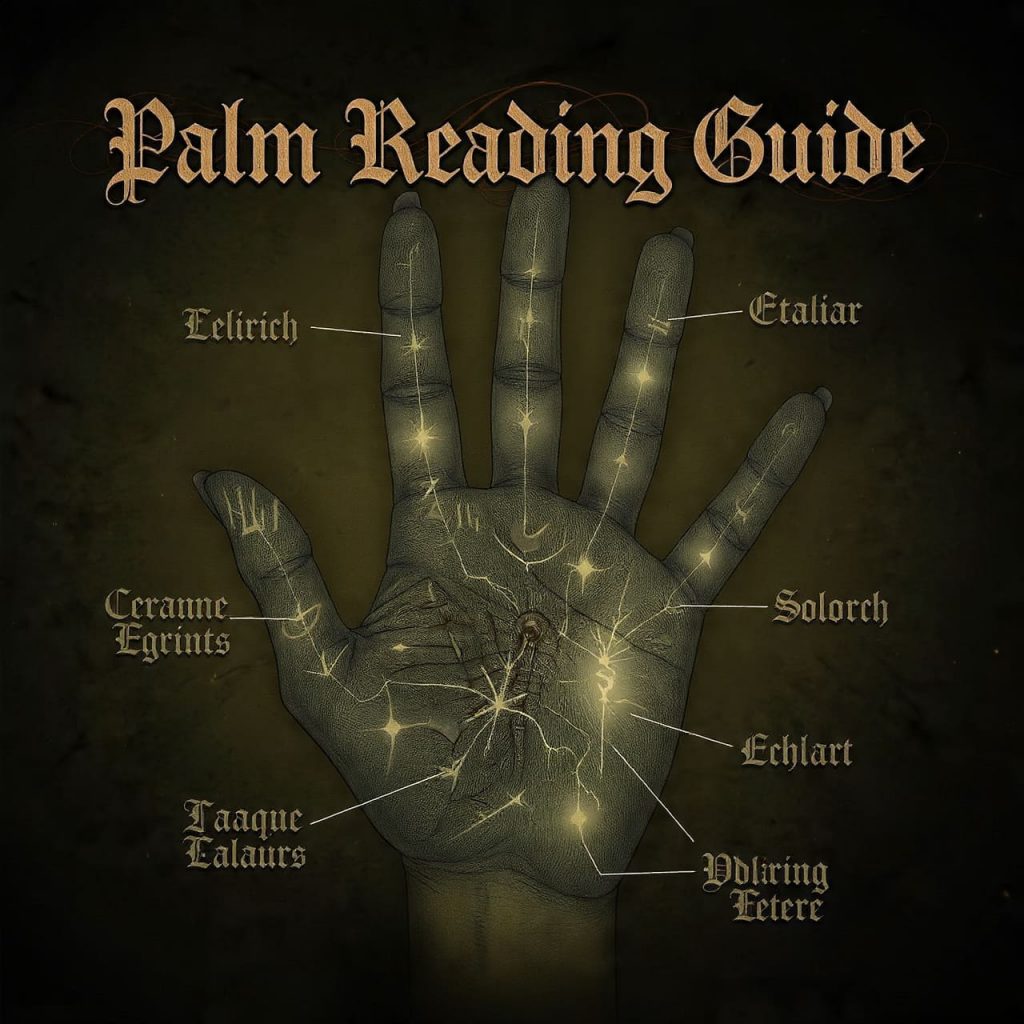
Palm reading—also known as palmistry—is one of the world’s oldest symbolic systems for exploring personality, emotional tendencies, resilience, and the ways individuals adapt over time. Contemporary palm readers emphasize interpretation, not prediction; psychology, not superstition; and self-understanding, not fate. In this Palm Reading Guide, we explore a complete framework for interpreting the palm through a balanced, grounded, and comprehensive lens suitable for both beginners and advanced readers.

💜 Need a clear answer right now?
CONSULT THE YES OR NO TAROT Free · No registration · Instant resultThis guide covers the major and minor lines of the hand, hand shapes, mounts, finger structures, patterns of stress and resilience, developmental indicators, case studies, misconceptions, and modern practitioner approaches. Many readers begin by refining their questions using reflective frameworks, often inspired by using strategies explained in palm reading, to ensure their session or self-study remains meaningful and focused.
Understanding Palmistry as a Reflective Tool
Palmistry is not about foreseeing destiny. It is a symbolic tool that captures psychological patterns, emotional tendencies, and adaptive responses to life. Some individuals contextualize personality and emotional cycles with tools like horoscope insights, and palmistry complements these systems by providing a physical, evolving map of identity.
Palmistry explores:
- How a person responds to emotional tension
- How they make decisions and process information
- How they express affection, trust, and boundaries
- Which strengths are emerging or evolving
- How major transitions impact identity
- Where resilience is forming
- How life experiences reshape patterns over time
Practitioner Insight
Dr. Rowan Min, a cognitive-development specialist and palmistry researcher (PhD, Psychology), explains:
“Palmistry is not predictive. The lines on the hand reflect lived experience and internal processes. They shift gradually with emotional development, stress patterns, habits, and self-perception.”
Seeing the hand as a dynamic map is central to modern palm reading.
Online Palm Reading and the Value of Digital Interpretation
Online analysis via online tarot sessions has broadened access to palmistry. Clients send high-resolution hand photos and receive insights without needing an in-person appointment, allowing for thoughtful, in-depth interpretation.
Online palm reading highlights:
- Stability and adaptability shown in the Life Line
- Mental clarity and learning patterns from the Head Line
- Emotional expression through the Heart Line
- Career orientation inferred from the Fate Line
- Communication tendencies through Mercury-related lines
- Stress markers detected in bar lines or breaks
- Habitual patterns shown in mounts and finger angles
Case Study
Client: 25-year-old overwhelmed by career indecision.
Findings:
- A gently sloping Head Line indicated open-minded problem-solving
- A weak early Fate Line suggested exploratory life stages
- A strengthened Fate Line mid-palm reflected increasing direction
Outcome:
Client gained confidence pursuing a flexible career path.
Video-Based Palm Reading: Observing Subtle Movement and Texture
Live sessions through video readings allow practitioners to observe dynamic features of the hand—movement, texture, flexibility, and responsiveness—which greatly enrich interpretation.
Video sessions reveal:
- Hand flexibility (emotional adaptability)
- Knuckle tension (analytical or defensive tendencies)
- Skin texture (sensitivity vs. resilience)
- Thumb strength (willpower and self-direction)
- Mount prominence (core drivers like logic, passion, intuition)
Practitioner Observation
Elise Hartwell, palm reader and body-language specialist, notes:
“Hands reveal tension long before words do. Flexibility, stiffness, and posture explain more about someone’s emotional reality than line structure alone.”
Case Example
Client: adjusting to major life changes.
Observations:
- Flexible Head Line region → cognitive adaptability
- Strong Jupiter mount → leadership tendencies emerging
- Shifting Life Line structure → emotional recalibration
These details enriched the interpretation far beyond static imagery.
Voice-Based Palmistry: Interpretive Work Through Dialogue
Phone readings through phone readings incorporate client descriptions of their palm lines with practitioner guidance. This approach often surfaces deeper emotional truth because clients articulate their hand features alongside their lived experiences.
Phone-based interpretation helps clarify:
- Emotional narratives connected to Heart Line patterns
- Cognitive themes aligned with Head Line structure
- Stability and grounding reflected in the Life Line
- Personal growth indicated by Fate Line developments
- Past experiences shaping line changes
Practitioner Insight
Without visual pressure, clients often reveal vulnerable insights that shape interpretation more authentically.
The Heart Line: Emotional Patterns and Relational Themes
The Heart Line explores how individuals express love, trust, boundaries, empathy, and emotional self-regulation. These insights often support work similar to topics discussed in love tarot readings.
Heart Line variations:
- Deep and curved → emotionally expressive, intuitive
- Straight and long → rational, grounded, self-contained
- Short or faint → cautious or private in emotional sharing
- Forked ending → balanced emotional perspective
- Chained → sensitivity, complexity, or emotional overload
Case Study
Client: difficulty trusting romantic partners.
Palm Findings:
- Several interruptions in the Heart Line
- A split ending indicating ambivalence toward vulnerability
Interpretation:
Not a prediction of trust issues—an emotional pattern requiring awareness and healing.
The Life Line: Resilience, Grounding, and Adaptation
Modern palm readers—especially those certified through qualified professionals—emphasize that the Life Line does not reflect lifespan. Instead, it represents energy patterns, grounding, adaptability, and responses to stress.
Life Line meanings:
- Long and deep → stable energy, grounding
- Short but strong → efficient energy, discipline
- Breaks → emotional transitions, major life shifts
- Wide arc → adventurous, outward-oriented
- Narrow arc → preference for familiarity and security
Practitioner Insight
Dr. Min states:
“The Life Line is a psychological signature, not a biological one.”
The Head Line: Thinking Style, Mental Processing, and Perspective
Clients often seek practitioners recognized among reliable readers to interpret their Head Line—one of the most important indicators of cognitive patterns.
Head Line interpretations:
- Straight → logical, systematic, structured thinking
- Curved → creative, emotionally sensitive cognition
- Steep downward slope → introspection, imagination
- Upward tilt → optimism, decisive thinking
- Breaks → mental overload or disruptive transitions
Case Study
Client: wondering about suitability for a creative field.
Palm Findings:
- A broad, curved Head Line
- Strong Apollo mount
Interpretation:
Not a guarantee of success—an indication of creative alignment and potential.
Techniques for Interpreting Palm Reading Lines
Advanced practitioners use structured tools and analytical frameworks to read hands with depth and accuracy.
1. Tri-Line Integration
Examines how Life, Head, and Heart lines interact to form a cohesive emotional-cognitive profile.
2. Pattern Flow Mapping
Tracks how experience shapes line development over time.
3. Cognitive-Emotional Balance Assessment
Compares the Head and Heart lines to reveal decision-making tendencies.
4. Resilience and Boundary Analysis
Analyzes thumb set, Life Line curvature, and Venus mount.
5. Purpose Arc Interpretation
Explores long-term direction using the Fate Line and Jupiter mount.
6. Stress Signature Review
Identifies bar lines, crosshatching, and fragmentation that reflect emotional pressure.
7. Adaptability Curve Technique
Reviews palm flexibility and movement patterns to measure emotional range.
Case Study #1: Emotional Growth Reflected in Palm Changes
Client: 20-year-old experiencing increased independence.
Findings:
- Life Line became deeper over time
- Heart Line gained clarity
- New upward Fate Line branch appeared
Interpretation:
Emotional maturity and sense of purpose strengthening—not a prediction of life events.
Case Study #2: Creative Awakening
Client: exploring artistic identity.
Key features:
- Strong Apollo Line
- Curved Head Line
- Prominent Moon mount
Outcome:
Client embraced creative pursuits with renewed confidence.
Case Study #3: Overcoming Stress and Rebuilding Cognitive Clarity
Client: academic pressure causing burnout.
Findings:
- Fragmented Head Line
- Downward stress markings
Interpretation:
Symbolic indicators of cognitive strain and need for recovery-focused habits.
Misconceptions About Palm Reading
Misunderstandings often prevent individuals from appreciating palmistry’s depth.
“Palm reading predicts the future.”
Modern palmistry interprets patterns, not fate.
“Short Life Line = short life.”
No scientific or symbolic basis; reflects energy use and grounding.
“Palmistry is unchanging.”
Lines evolve with experience and emotional development.
“Palm reading is mystical or dangerous.”
It is a symbolic system for self-reflection.
“Only the major lines matter.”
Minor lines greatly influence nuance.
Table: Palm Line Meaning Summary
| Line | Represents | Useful For |
|---|---|---|
| Life Line | Vitality, resilience | Understanding grounding & stress response |
| Head Line | Thinking style | Cognitive habits, learning style |
| Heart Line | Emotional expression | Relationship tendencies |
| Fate Line | Direction & responsibility | Purpose and life structure |
| Mercury Line | Communication | Expression and intuition |
| Sun Line | Creativity | Passion and recognition |
| Minor Lines | Stress, adaptability | Nuanced emotional insights |
Final Guidance for Meaningful Palm Reading
Palmistry becomes deeply effective when clients approach it with reflective intention rather than expectation. Practitioners often encourage individuals to clarify their self-inquiry using frameworks similar to using strategies explained in palm reading. The process emphasizes alignment, emotional awareness, and psychological insight, allowing palm reading to illuminate personal growth pathways rather than predict outcomes.
Frequently Asked Questions
Does palm reading predict the future?
No. It interprets psychological patterns.
Why do my lines look different from others?
Each person’s lines reflect unique experience and emotional development.
Do palm lines really change?
Yes—gradually and subtly, shaped by personal growth and habits.
What hand should I read?
Dominant hand reflects active patterns; nondominant shows underlying potential.
Is palm reading scientific?
It is symbolic, not scientific, but psychologically meaningful when done responsibly.
Can palm reading guide major decisions?
It offers clarity—not instructions.
Are broken lines bad?
No. They usually reflect transitions, stress, or emotional evolution.
Conclusion
Palm reading is a rich symbolic tradition that illuminates emotional tendencies, cognitive styles, resilience patterns, and personal growth. Modern practitioners approach it with psychological grounding rather than prediction, helping individuals understand themselves through the evolving lines and structure of the hand. When interpreted thoughtfully, palmistry becomes a profound tool for self-awareness, personal reflection, and insight into how one’s internal world continues to grow and transform.
